
Concept
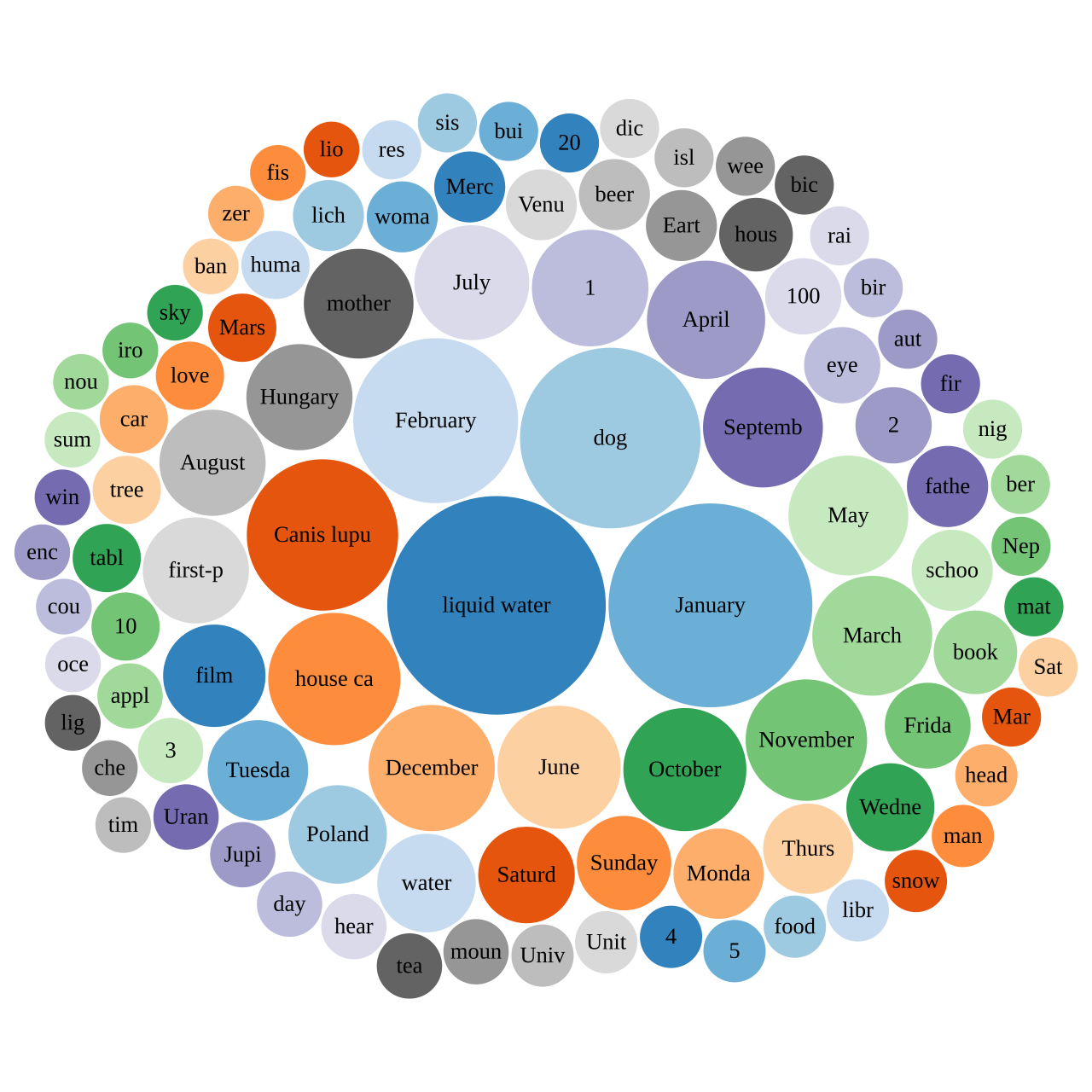
Fundamental cognitive units that classify entities and encode shared features.

So9q · CC0
Concepts are fundamental units of cognition that classify entities and encode shared features. They make it possible to form and combine ideas, draw inferences, and refer to external objects, acting as the meanings of words and playing a central role in many cognitive processes, including perception, memory, and reasoning.
- field
- Philosophy, psychology, linguistics, cognitive science
- known_for
- Fundamental units of cognition; basis for categorization, inference, and meaning
- types
- Simple and complex, learned and innate, concrete and abstract, natural and logical
- theories
- Classical theory, prototype theory, exemplar theory, theory theory, conceptual atomism
Lore & Background
Concepts are components of thought but not fully formed thoughts: they are subpropositional units, like the concept baby, that do not amount to complete propositions. They apprehend the character of something without asserting or negating anything about it. Concepts are closely related to language and are often characterized as the meanings of words, though different words can express the same concept, and a single word can have several meanings. Researchers distinguish different types of concepts based on their internal structure, mode of acquisition, and domain. These include simple and complex concepts, learned and innate concepts, concrete and abstract concepts, and natural and logical concepts. The classical theory holds that concepts are essentially definitions, each characterized by fixed rules determining to which entities the concept applies. Prototype theory rejects this outlook, arguing that concept membership depends on similarity to a prototype—a cluster of features typically associated with the category. According to exemplar theory, similarity derives from individual memories of concrete instances rather than a single prototypical summary representation. Theory theory maintains that concepts are embedded in domain-specific theories, while conceptual atomism argues that lexical concepts are separate units without internal structure. Concept learning is the process of acquiring a new concept, which is required before an individual can use it. Suggested learning mechanisms include associative learning, in which similarities are gradually noticed as learners encounter instances, and hypothesis testing, which involves formulating testable rules. Nativism and empiricism are competing theories about whether there are inborn concepts not learned from experience. Researchers also examine how concept learning develops from childhood to adulthood, how nonhuman animals form concepts, and how computers can model and acquire concepts.
Reader's Guide
Concepts are central to human cognition, serving as the building blocks for categorization, inference, reasoning, language, and decision-making. They allow individuals to simplify the complexity of the world by grouping objects and events into classes, reducing cognitive load and enabling fast, often unconscious, categorization that is vital for survival and everyday functioning. Concepts structure perception, guide attention, organize memory, and facilitate learning through generalization and abstraction. They also play a key role in communication and social coordination by serving as stable meanings that people can transmit and share. The study of concepts is relevant to many fields, including philosophy, psychology, linguistics, and cognitive science. Inquiry into their nature originated in antiquity and became a central topic in the 20th century as researchers discussed various theories of concepts and the cognitive mechanisms underlying them. The exact definition of a concept is disputed and varies by discipline, with ongoing debates about whether concepts are mental representations or abstract objects that exist independently of individual minds.
Did You Know?
- Concepts are subpropositional units: they are components of thought but not fully formed thoughts, such as the concept baby versus the statement 'the baby is sleeping'.
- There are empty concepts without real-world instances, like the concept unicorn.
- Conceptual capacities are primarily associated with humans, but in a broader sense, they are also attributed to some nonhuman animals.
The Cognitive Architecture of Concepts
Concepts serve as the foundational building blocks through which minds organize and make sense of the world. Rather than being complete thoughts or statements, they operate as subpropositional units—grasping the character of a thing without asserting or denying anything about it. The concept 'baby' captures a kind of entity, while 'the baby is sleeping' constitutes a full proposition. This distinction places concepts as components of thought rather than thoughts themselves.
Each concept carries an intension, the set of features it encodes, and an extension, the collection of real-world entities it applies to. The concept 'city' extends to New York, Paris, and Tokyo, while its intension captures what makes something a city. Some concepts, like 'unicorn,' have extensions with no real instances, and singular concepts like 'Mars' refer to exactly one entity.
Crucially, concepts are not the only way the mind registers information. Nonconceptual contents—raw sensory data such as distinguishing subtle shades of red—can be perceived without the possessor having a distinct concept for each variation. This suggests that perception carries more informational richness than conceptual grasp alone.
Competing Theoretical Frameworks
The nature of concepts has generated a rich landscape of competing theories. Classical theory treats concepts as rigid definitions, where fixed necessary and sufficient rules determine exactly which entities fall under a category. Prototype theory challenges this rigidity, proposing instead that membership is a matter of degree—how closely an entity resembles a typical cluster of features associated with that category.
Exemplar theory pushes further, arguing that similarity is not computed against a single summary prototype but against stored memories of individual concrete instances one has encountered. Theory theory embeds concepts within broader domain-specific explanatory frameworks, while conceptual atomism takes the opposite structural view, holding that lexical concepts are unanalyzable units without internal composition.
Beyond these structural debates, philosophers split on whether concepts are mental representations internal to individual minds or abstract objects that exist independently of any thinker. Nativism and empiricism offer rival accounts of origin: whether some concepts are inborn or whether all must be constructed from experience. These disagreements remain unresolved and continue to shape research across psychology, philosophy, and cognitive science.
Acquisition, Development, and Cross-Species Inquiry
Before a concept can be deployed in thought or speech, it must first be acquired. Researchers identify several candidate mechanisms for this learning process. Associative learning posits that as a learner repeatedly encounters instances of a category, similarities gradually emerge and the concept crystallizes. Hypothesis testing offers a more active model, in which the learner formulates tentative rules and tests them against new examples to refine the concept's boundaries.
The question of whether any concepts are inborn—nativism—versus the claim that all concepts must be built from sensory experience—empiricism—remains a central dividing line. Developmental research tracks how concept learning unfolds from childhood through adulthood, examining what changes in the sophistication and breadth of conceptual knowledge over a lifetime.
Inquiry extends beyond human cognition as well. Researchers investigate how nonhuman animals form and use concepts, probing the limits of conceptual capacity across species. Computational science contributes by building models that attempt to simulate how machines might acquire and represent concepts, offering testable formalizations of the mechanisms proposed by cognitive theorists.
Hierarchy, Linguistic Ties, and the Word–Concept Distinction
Concepts are not flat collections; they organize into multi-level hierarchies. A superordinate concept like 'animal' encompasses subordinate concepts such as 'mammal,' which in turn subordinates 'fox.' Members of a subordinate category inherit the defining features of every superordinate level above them, creating a nested architecture of generality.
The relationship between concepts and language is intimate but not identical. Concepts are often described as the meanings of words, yet the mapping is many-to-many: different words can express the same concept, and a single word can carry multiple meanings. A person can learn a word without grasping its meaning, or possess a concept for which no word exists in their vocabulary. This separation underscores that conceptual capacity is a cognitive achievement distinct from linguistic knowledge.
The term 'concept' itself traces back to the Latin concipere, meaning 'to conceive' or 'to take in.' Through the perfect participle conceptus, it entered Middle English, with the earliest documented use dating to 1479. The conceptual capacities most associated with humans are, in a broader sense, also attributed to some nonhuman animals, though the depth and scope of that attribution remain subjects of ongoing investigation.
Gallery




Frequently Asked Questions
What is a Concept in philosophy and cognitive science?
A concept is the basic mental building block that lets us group things together by their shared properties. It functions as the underlying meaning behind words and enables us to reason, perceive, and remember.
What types of concepts exist?
Concepts can be broken down along several axes: simple versus complex, learned versus innate, concrete versus abstract, and natural versus logical. This variety reflects how differently we handle everyday objects compared to abstract ideas like justice or numbers.
What are the main theories of concepts?
The major competing frameworks include the classical theory, prototype theory, exemplar theory, theory theory, and conceptual atomism. Each offers a different account of how the mind stores, retrieves, and applies categorical knowledge.
Why do concepts matter across philosophy, psychology, and linguistics?
They sit at the intersection of several disciplines because they underpin categorization, inference, and meaning-making. Without concepts, coherent thought, language use, and problem-solving would be impossible.
How do concepts connect to language and word meaning?
Concepts serve as the mental referents that words point to, making them the semantic core of linguistic expression. They allow speakers to refer to external objects and combine ideas into complex thoughts through grammar and syntax.
More in Philosophical Concepts 1-24
Elsewhere in the Philosophical Concepts universe
Spotted an error? Know more?
This is a living reference — every entry is fact-audited, and reader corrections feed straight into our audit queue. Suggest an edit · See this site's audit record