
Inductive reasoning
Reasoning that yields probable, not certain, conclusions.
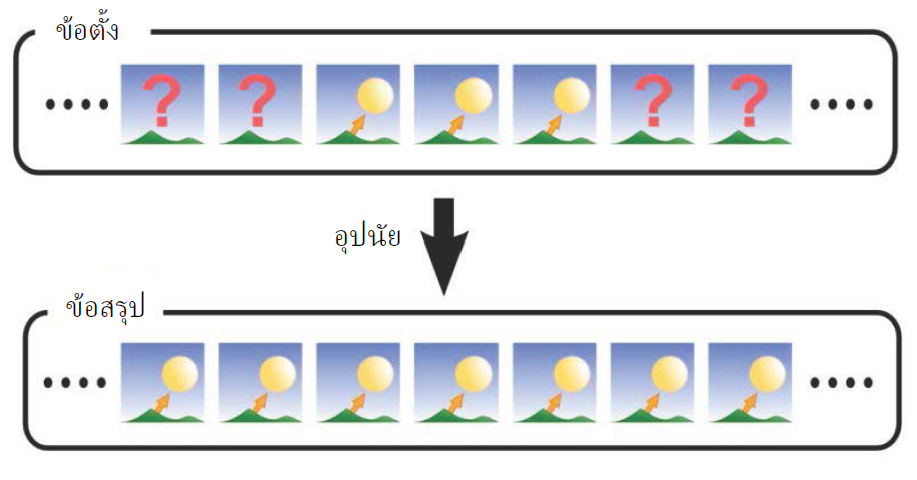
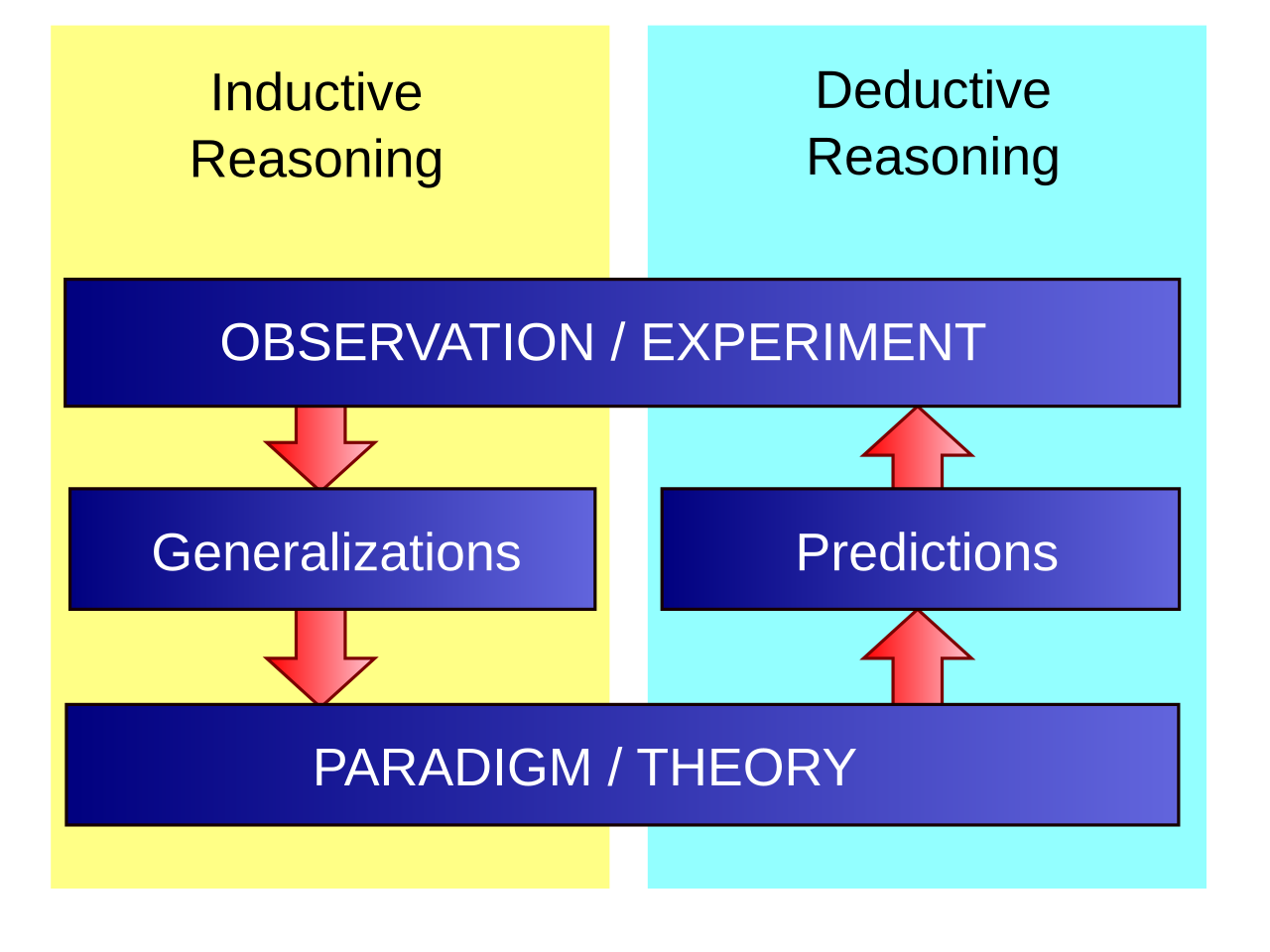
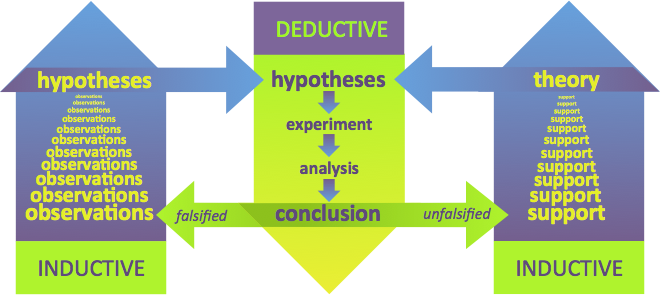
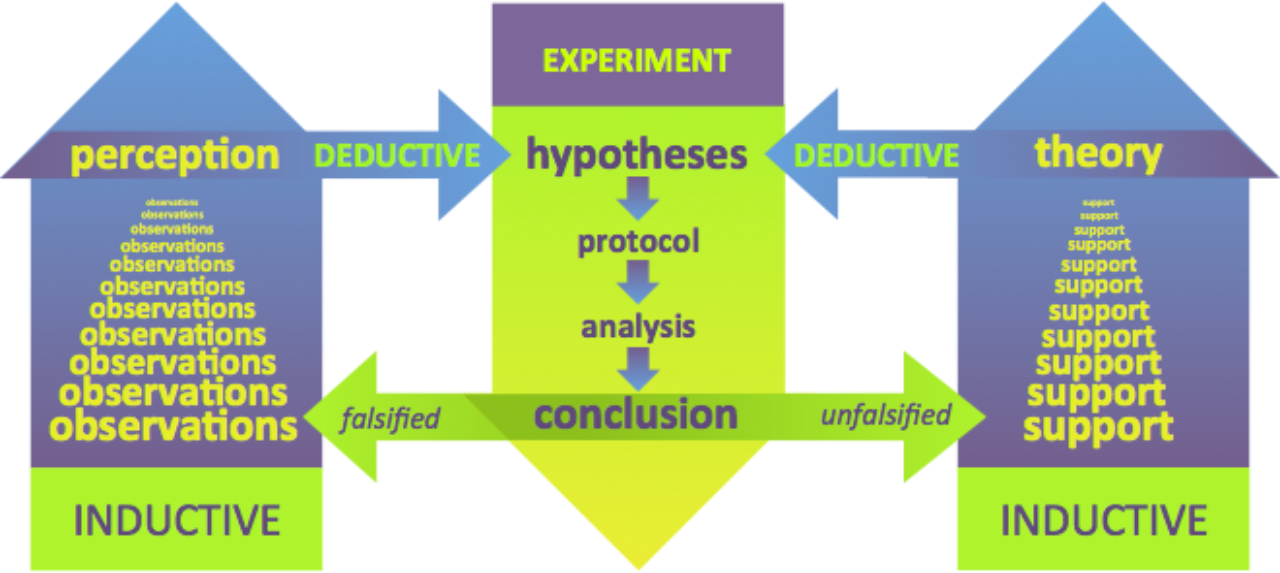
Inductive reasoning covers a range of logical approaches where the conclusion is not guaranteed to be true, even if the premises are correct. Instead, the best it can offer is a certain level of probability. This sets it apart from deductive reasoning, where a correct premise leads to a certain conclusion. The main forms of inductive reasoning are generalization, prediction, statistical syllogism, argument from analogy, and causal inference.
**Inductive generalization** moves from specific observations of a sample to a broader claim about the entire population. The observed trait in the sample is projected onto the larger group. For instance, if a sample of four balls from an urn containing 20 black and white balls yields three black and one white, one might generalize that the urn holds 15 black and five white balls. However, this is just one of 17 possible combinations—the actual count could range from 19 black and one white to three black and 17 white. The likelihood of each possible distribution can be estimated using methods like Bayesian inference, which updates prior assumptions with sample data, or maximum likelihood estimation (MLE), which finds the distribution most consistent with the observed sample. The strength of the conclusion depends on the sample size relative to the population, how well the sample represents the population (often achieved through random sampling), and the reliability of the observation method. Larger, more representative samples yield stronger generalizations. Fallacies in this area include hasty generalization and biased sampling.
**Statistical generalization** infers a conclusion about a population from a statistically representative sample. For example, if a large random survey of voters shows 66% support for Measure Z, the conclusion is that roughly 66% of all voters support it. This inference is highly reliable within a defined margin of error, provided the sample is genuinely random and the numbers of items with the relevant properties are large. Compare this to a weak argument like: "Six of ten people in my book club are Libertarians, so about 60% of people are Libertarians." That argument fails because the sample is non-random and very small. Statistical generalizations are also called statistical projections or sample projections.
**Anecdotal generalization** uses a non-statistical sample to draw a conclusion about a population, relying on anecdotal evidence. For instance, if a son's Little League team has won 6 of 10 games so far this year, one might conclude they will win about 60% of games by season's end. This inference is less reliable than a statistical generalization—and more prone to the hasty generalization fallacy—because the sample events are non-random and cannot be expressed mathematically. There is no way to know or measure all future circumstances affecting performance. Philosophically, such arguments assume that future events will mirror the past, a presupposition known as the uniformity of nature, which cannot be proven from empirical data. Arguments that implicitly rely on this uniformity are sometimes called Humean, after the philosopher who first critically examined them.
**Prediction** draws a specific conclusion about a future, current, or past instance based on a sample of other instances. Unlike inductive generalization, which ends with a general statement, prediction ends with a specific statement about the probability that a single instance will (or will not) share an attribute with the observed instances. For example: if a certain proportion Q of observed group G has attribute A, then there is a probability of about Q that another member of G will have A when next observed.
**Statistical syllogism** moves from a generalization about a group to a conclusion about an individual. For instance: 90% of graduates from Excelsior Preparatory school attend university. Bob is a graduate of that school. Therefore, Bob will probably attend university. Even though Bob's attendance is not certain, the exact probability is derived from the group statistic.
- field
- Logic and reasoning
- known_for
- Methods of reasoning where conclusions are probable, not certain
- types
- Inductive generalization, prediction, statistical syllogism, argument from analogy, causal inference
- methods
- Enumerative induction and eliminative induction
Lore & Background
Inductive reasoning encompasses a variety of methods, including inductive generalization, which proceeds from premises about a sample to a conclusion about a population. For example, drawing a sample of four balls from an urn containing 20 black or white balls may lead to a generalization about the total numbers of each color, though many possible distributions exist. The strength of such a generalization depends on sample size, population size, and how representative the sample is. Statistical generalization uses a statistically representative sample to infer about a population, while anecdotal generalization relies on non-statistical samples and is less reliable.
Reader's Guide
Inductive reasoning is significant because it underpins much of everyday inference and scientific reasoning, though its conclusions are never certain. The article notes that the probability of each possible distribution can be estimated using techniques such as Bayesian inference or maximum likelihood estimation. The reliability of inductive arguments varies: statistical generalizations are highly reliable within a well-defined margin of error if the sample is random and large, while anecdotal generalizations are more prone to fallacies like hasty generalization. The article also discusses argument from analogy and causal inference, noting that analogical reasoning is frequent in common sense, science, philosophy, law, and the humanities, but can mislead if not all relevant comparisons are made. The two principal methods for reaching inductive generalizations are enumerative induction and eliminative induction.
Did You Know?
- Inductive reasoning produces conclusions that are at best probable, not certain.
- Types of inductive reasoning include generalization, prediction, statistical syllogism, argument from analogy, and causal inference.
- A statistical generalization is highly reliable within a well-defined margin of error if the selection process was genuinely random and sample numbers are large.
- The two principal methods used to reach inductive generalizations are enumerative induction and eliminative induction.
The Probabilistic Nature of Inductive Reasoning
Inductive reasoning occupies a fundamentally different epistemic space than deductive reasoning. Where deductive arguments—like mathematical induction—guarantee that a conclusion follows with absolute certainty once the premises are accepted, inductive arguments can only ever deliver a conclusion that is probable to some degree. The conclusion is supported by the premises, but never locked in by them. This means that even a perfectly structured inductive argument leaves room for the conclusion to be wrong. The reasoning methods encompassed under this umbrella include generalization, prediction, statistical syllogism, argument from analogy, and causal inference, each producing conclusions that carry a degree of likelihood rather than logical necessity. This probabilistic character is not a flaw but the defining feature: inductive reasoning is the tool we reach for when the world presents us with incomplete data and we must still draw conclusions about what is likely true.
From Sample to Population: The Art of Generalization
Inductive generalization is the process of taking observations made on a subset and projecting them onto the whole population. A classic illustration involves an urn holding twenty balls of two colors: drawing four balls and finding three black and one white might lead one to estimate fifteen black and five white in the urn. Yet that estimate is merely one among seventeen possible distributions. The strength of such a generalization hinges on several factors: how large the sample is relative to the population, how well the sample mirrors the whole, and the reliability of the observation procedure itself. Two distinct flavors emerge. A statistical generalization—like surveying a large random sample of voters and concluding that roughly 66 percent support a measure—carries a quantifiable margin of error and is highly reliable when the selection is genuinely random. An anecdotal generalization, by contrast, rests on non-random, non-quantifiable evidence, such as extrapolating a Little League team's early-season record to the full season. The former is mathematically grounded; the latter is vulnerable to the hasty generalization fallacy.
Predicting the Individual and the Specific
Beyond sweeping statements about populations, inductive reasoning also targets particular instances. An inductive prediction takes a pattern observed across multiple cases and applies it to a single future, present, or past occurrence. If a proportion Q of observed members of a group display attribute A, the prediction concludes that the next member observed will likely share that attribute with a probability matching Q. A statistical syllogism operates in the reverse direction: it starts from a group-level generalization and draws a conclusion about one specific individual. For instance, if ninety percent of graduates from a particular preparatory school proceed to university, and Bob is one such graduate, it follows that Bob will probably attend university. The probability is fully determined given the available information, yet the outcome remains uncertain. This structure is susceptible to two specific fallacies known as dicto simpliciter errors: the accident fallacy and the converse accident fallacy, both of which arise when the group statistic is misapplied to an individual who may be an exception.
The Philosophical Underpinning: Uniformity of Nature
Beneath every inductive inference lies a philosophical assumption that cannot itself be proven from the data. Anecdotal generalizations, for example, tacitly depend on the presupposition that the operation of future events will mirror what has been observed in the past. This is the principle of the uniformity of nature—an unproven axiom that cannot be derived from empirical evidence alone. The philosopher David Hume was the first to subject this assumption to rigorous philosophical scrutiny, which is why arguments that quietly rely on it are sometimes labeled Humean. This philosophical vulnerability is not unique to anecdotal reasoning; it permeates all inductive methods. Whether one is estimating ball colors in an urn, projecting a voter survey, or predicting an individual's behavior from group statistics, the underlying move is the same: assuming that the patterns observed so far will continue to hold. Bayesian inference and maximum likelihood estimation offer powerful tools for updating beliefs in light of new data, yet they do not eliminate the foundational assumption that the world operates with some degree of regularity.
Gallery
Frequently Asked Questions
What is inductive reasoning?
Inductive reasoning is a family of logical methods in which you move from specific observations to a broader conclusion that is likely but never guaranteed. Unlike deduction, which delivers certainty, induction only ever gets you as far as probability.
How does inductive reasoning differ from deductive reasoning?
In deduction, true premises force the conclusion to be true; in induction, true premises merely make the conclusion probable. This means inductive arguments are judged as strong or weak rather than simply valid or invalid.
What types of inductive reasoning exist?
The main varieties include generalization, prediction, statistical syllogism, argument from analogy, and causal inference. Each uses a different pattern of evidence to support a likely-but-not-certain conclusion.
Why is inductive reasoning important in philosophy and science?
Because most scientific and everyday conclusions go beyond what the premises strictly guarantee, induction is the engine behind hypothesis formation, pattern recognition, and forecasting. Without it, we could never extend knowledge past the data we already possess.
What specific methods fall under inductive reasoning?
Two core methods are enumerative induction (generalizing from repeated observations) and eliminative induction (narrowing down possible causes by ruling out alternatives). Both aim to arrive at the most probable explanation rather than a logically forced one.
More in Philosophical Concepts 1-24
Spotted an error? Know more?
This is a living reference — every entry is fact-audited, and reader corrections feed straight into our audit queue. Suggest an edit · See this site's audit record